
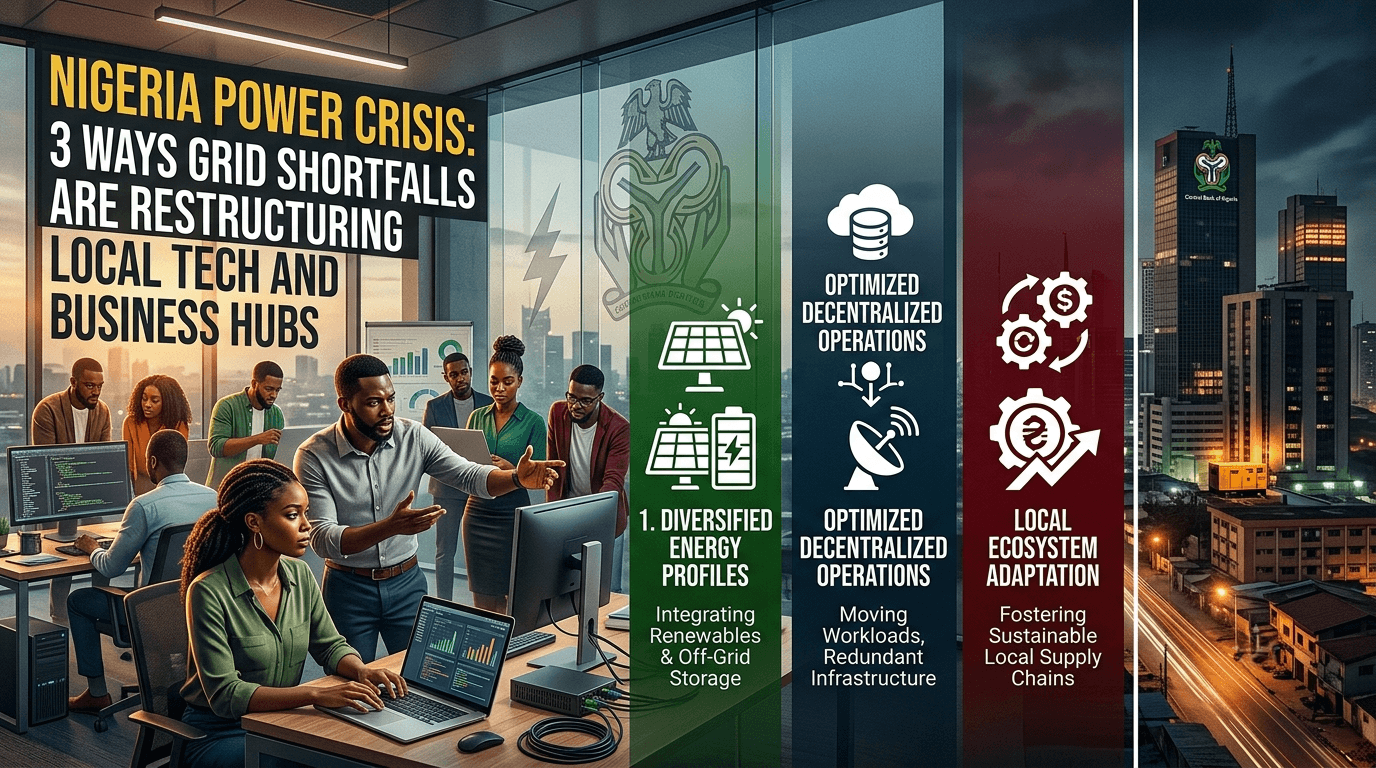
The Nigeria power crisis has become a defining challenge for the nation’s rapidly expanding digital economy. As entrepreneurs strive to build innovative solutions, they face a landscape where unreliable electricity threatens daily operations.
This persistent energy crisis in nigeria forces companies to rethink their fundamental strategies. To survive, businesses are moving away from traditional models and embracing decentralized infrastructure.

Tech hubs are now leading the charge by integrating renewable sources and localized micro-grids. These adaptations ensure that vital services remain online despite broader infrastructure failures. By prioritizing resilience, local firms are turning a significant obstacle into a catalyst for sustainable growth.
Key Takeaways
- Unreliable electricity is forcing a shift toward decentralized business models.
- Tech hubs are adopting renewable energy to maintain operational continuity.
- Micro-grids are becoming essential tools for modern digital enterprises.
- Infrastructure challenges are driving innovation in energy management.
- Resilience has become a core competitive advantage for local startups.
The Current State of the Nigeria Power Crisis
Frequent power grid failure events have become a defining characteristic of the modern Nigerian business environment. These recurring disruptions create a volatile landscape where consistent productivity remains elusive for many organizations. The persistent electricity shortage in Nigeria forces companies to navigate a complex web of supply gaps that hinder daily operations.
Systemic weaknesses within the national infrastructure are the primary drivers of this instability. Aging transmission lines and insufficient generation capacity prevent the grid from meeting the demands of a growing population. Consequently, businesses often face unpredictable outages that threaten their long-term viability and growth potential.
The impact of these challenges extends beyond simple inconvenience, as they fundamentally alter how local firms plan their budgets. Many enterprises must allocate significant capital toward backup power solutions just to maintain basic functionality. This electricity shortage in Nigeria acts as a hidden tax on innovation, diverting resources away from research and development.
Ultimately, the frequency of power grid failure serves as a catalyst for the rapid adoption of decentralized energy models. Entrepreneurs are no longer waiting for centralized improvements to solve their energy needs. Instead, they are actively seeking sustainable alternatives to ensure their businesses remain competitive in an increasingly digital economy.
Decentralization of Energy Infrastructure in Tech Clusters
Tech clusters across Nigeria are now building their own energy future to bypass the limitations of traditional infrastructure. This shift represents a fundamental change in how startups approach operational stability. By moving away from the national grid, these hubs are creating resilient environments that foster continuous innovation.
The Shift from Centralized Grid Dependency
For years, the persistent power outage problem has hindered the growth of digital enterprises. Relying on a single, unstable source of electricity is no longer a viable business model for modern tech companies. Many firms are now prioritizing energy autonomy to protect their servers and development timelines.
This transition involves moving toward localized power generation that operates independently of the main grid. By taking control of their own energy needs, businesses can avoid the unpredictable nature of the national supply. This strategy is essential for maintaining the high uptime required by global software clients.
Microgrid Implementation in Yaba and Lekki
In major hubs like Yaba and Lekki, microgrids are becoming the new standard for tech innovation. These localized systems allow clusters of offices to share power resources efficiently. This collaborative approach effectively mitigates the impact of any sudden energy supply disruption.
Microgrid technology provides a reliable buffer against the broader grid’s failures. By pooling resources, startups in these areas can invest in high-capacity solar arrays and battery storage. This collective investment ensures that critical development work continues even when the main grid falters.
Ultimately, these decentralized solutions are transforming the landscape of Nigerian tech. They provide the stability necessary for long-term growth and international competitiveness. As more hubs adopt these models, the reliance on traditional, failing infrastructure will continue to decline.
The Rise of Solar-Powered Co-working Spaces
Innovation often thrives where traditional infrastructure fails, leading to the rapid rise of solar-powered co-working spaces across Nigeria. These hubs provide a sanctuary for founders who are tired of the constant electricity deficit nigeria faces daily. By integrating renewable energy, these spaces ensure that digital businesses remain operational regardless of grid performance.
Sustainable Energy as a Competitive Advantage
For many modern startups, consistent power is no longer a luxury but a critical necessity for survival. Businesses that operate out of solar-powered hubs gain a significant edge over competitors who struggle with frequent energy supply disruption. This reliability allows teams to maintain consistent development cycles and meet client deadlines without interruption.
“True innovation in the Nigerian tech ecosystem is being driven by those who solve their own infrastructure challenges through sustainable, off-grid solutions.”
Investors are increasingly looking for startups that demonstrate this level of operational resilience. By choosing a workspace powered by the sun, companies signal that they are prepared to scale despite the broader electricity deficit nigeria presents. This strategic choice turns a potential weakness into a robust competitive advantage.
Reducing Operational Costs for Startups
The financial burden of running diesel generators is a major hurdle for early-stage companies. Relying on fossil fuels creates a volatile expense that fluctuates with global oil prices and local logistics. Solar-powered co-working spaces eliminate this burden, allowing founders to redirect their limited capital toward growth and product development.
Moving away from the constant threat of energy supply disruption provides more than just peace of mind. It creates a predictable cost structure that is essential for long-term financial planning. Startups that leverage these green facilities are better positioned to survive the early years of business by keeping their overhead costs lean and manageable.
Shift Toward Energy-Efficient Software Development Practices
The ongoing power generation issues in Nigeria have sparked a quiet revolution in how local tech teams approach software architecture. As developers face the reality of an electricity deficit nigeria, they are moving away from resource-heavy applications toward leaner, more resilient solutions. This shift is not merely a technical preference but a survival strategy for businesses operating in volatile environments.

Optimizing Code for Low-Power Hardware
Engineers are now prioritizing code efficiency to ensure that applications run smoothly on low-power hardware, such as laptops running on battery or limited solar setups. By reducing the CPU load and memory footprint, developers can extend the operational life of their devices during outages.
Key strategies currently being adopted by local development hubs include:
- Minimizing background processes that consume unnecessary energy.
- Utilizing lightweight programming languages that require fewer system resources.
- Implementing aggressive caching mechanisms to reduce the need for constant server requests.
- Optimizing database queries to prevent excessive hardware strain.
The Impact of Power Instability on Development Cycles
Persistent power generation issues significantly disrupt the standard software development lifecycle. Frequent, unexpected shutdowns often lead to lost progress, corrupted files, and delayed deployment schedules. To mitigate these risks, teams are increasingly adopting offline-first development methodologies.
This approach ensures that developers can continue working locally without a constant internet or power connection. By syncing data only when stable energy is available, companies can maintain productivity despite the electricity deficit nigeria faces. Ultimately, this focus on resilience is fostering a culture of high-quality, efficient engineering that stands out on the global stage.
Economic Implications for Small and Medium Enterprises
The financial landscape for Nigerian startups is heavily dictated by the persistent lack of reliable power. For many local entrepreneurs, the dream of scaling is often stifled by the high cost of self-generated energy. This electricity shortage nigeria creates a barrier to entry that prevents many promising ventures from reaching their full potential.
Capital Expenditure on Diesel Generators
Most small and medium enterprises are forced to invest heavily in private power solutions to remain operational. The capital expenditure required to purchase and install industrial-grade diesel generators is often astronomical for a growing business.
Beyond the initial purchase price, these machines demand constant maintenance and a steady supply of fuel. This diverts essential funds away from product development, marketing, and hiring, which are the true drivers of long-term growth.
The Burden of Electricity Instability on Profit Margins
The ongoing electricity instability nigeria faces acts as a direct tax on the profit margins of local firms. When businesses must spend a significant portion of their monthly revenue on diesel, their ability to remain price-competitive in the market diminishes rapidly.
Many companies are forced to operate at reduced capacity because they cannot afford to run generators for a full eight-hour workday. This inefficiency limits output and prevents businesses from meeting customer demand, ultimately stalling the broader digital economy.
Ultimately, the persistent electricity instability nigeria creates a cycle of high overheads and low returns. Until reliable energy becomes a standard utility rather than a luxury, many SMEs will continue to struggle to maintain healthy bottom lines.
Regulatory Hurdles and Private Sector Interventions
Solving persistent power generation issues requires more than just technical fixes; it demands a significant shift in policy. While many businesses seek to bypass the national grid, they must still operate within a complex legal framework. Understanding these rules is essential for any company looking to invest in sustainable energy solutions.
The Nigerian Electricity Regulatory Commission (NERC) holds the mandate to oversee the power sector. For private firms, complying with these regulations often feels like a daunting task. Many startups struggle to obtain the necessary licenses for independent power production.
These regulatory barriers often exacerbate the effects of power grid failure across major tech hubs. Companies must balance the need for speed with the requirement for strict legal adherence. Without clear guidance, many potential energy projects remain stalled in the approval phase.
Public-Private Partnerships in Energy Distribution
Public-Private Partnerships (PPPs) are emerging as a viable solution to bridge the infrastructure gap. By pooling resources, the government and private investors can tackle power generation issues more effectively. These collaborations aim to modernize distribution networks that have suffered from years of neglect.
Successful partnerships often focus on localized distribution rather than national coverage. This approach allows for faster implementation and more reliable service for industrial clusters. The following table highlights the differences between traditional models and modern collaborative interventions.
| Feature | Traditional Grid | Private-Public Partnership |
|---|---|---|
| Reliability | Low (frequent power grid failure) | High (dedicated infrastructure) |
| Maintenance | Centralized and slow | Localized and proactive |
| Cost Structure | Subsidized but inconsistent | Market-driven and transparent |
| Scalability | Limited by legacy systems | Highly modular and flexible |
Technological Innovations in Off-Grid Power Management
Innovative energy management tools are becoming essential for companies facing the persistent power outage problem. As traditional infrastructure struggles to keep pace with demand, businesses are turning to digital solutions to gain control over their energy consumption. These technologies allow firms to optimize their limited resources effectively.
By integrating advanced hardware, organizations can mitigate the risks associated with electricity instability in Nigeria. This proactive approach ensures that critical systems remain operational even when the main grid fails. Modern management systems provide the visibility needed to make informed decisions about energy usage.
Smart Metering and IoT in Energy Monitoring
Smart metering combined with Internet of Things (IoT) sensors offers a granular view of energy flow within a facility. These devices track consumption patterns in real-time, allowing managers to identify energy-draining equipment. Data-driven insights help companies reduce waste and lower their overall utility expenses.
IoT platforms can automatically trigger load-shedding protocols during peak demand periods. This automation prevents system overloads and protects sensitive hardware from voltage fluctuations. By digitizing energy monitoring, businesses can maintain a stable environment for their digital operations.
Battery Storage Solutions for Business Continuity
Advanced battery storage systems serve as a vital buffer against the ongoing electricity instability in Nigeria. Lithium-ion technology has become the gold standard for businesses that require seamless power transitions. These systems store energy during periods of availability and discharge it instantly when the grid fails.
Investing in high-capacity storage is a strategic move for maintaining business continuity. It eliminates the need for noisy, polluting diesel generators that often cause maintenance headaches. With reliable storage, startups and established firms alike can focus on growth rather than the power outage problem that once hindered their daily productivity.
Future Outlook for Nigeria’s Digital Economy
Nigeria stands at a critical crossroads where energy innovation will define its technological trajectory. The current energy crisis in nigeria has long acted as a bottleneck for innovation, yet it also serves as a catalyst for creative, off-grid solutions. By prioritizing sustainable infrastructure, the nation can unlock unprecedented potential within its burgeoning tech ecosystem.

Scaling Renewable Energy for Industrial Growth
Transitioning to renewable energy sources is no longer just an environmental goal; it is an economic necessity for industrial expansion. Solar and wind power offer a reliable alternative to the traditional grid, allowing tech hubs to operate without constant interruptions. This shift ensures that data centers and software firms can maintain high uptime, which is vital for competing on a global scale.
Scaling these solutions requires a mix of policy support and private sector investment. When businesses move toward decentralized energy, they reduce their reliance on expensive diesel generators. This transition fosters a more stable environment where startups can focus on scaling their operations rather than managing power logistics.
“The true measure of a digital economy is not just the number of startups, but the reliability of the infrastructure that supports them.”
Attracting Foreign Investment Through Energy Reliability
Foreign investors prioritize stability when evaluating emerging markets. A consistent power supply is often the deciding factor for venture capitalists looking to fund local tech ventures. By addressing the blackout situation nigeria faces, the country can significantly improve its attractiveness to international stakeholders.
Reliable energy signals that a market is ready for high-level integration and long-term growth. When power instability is mitigated, the risk profile for foreign capital drops, leading to increased funding for local innovation. Ultimately, resolving the blackout situation nigeria is essential for the long-term sustainability of the digital economy and ensuring that the nation remains a competitive player in the global tech landscape.
Conclusion
Nigeria is witnessing a fundamental shift in how businesses operate and scale. The persistent blackout situation nigeria forces entrepreneurs to embrace decentralized energy models and sustainable technology. These adaptations prove that local hubs can thrive despite significant infrastructure gaps.
Three core strategies define this transformation. First, businesses now prioritize off-grid microgrids to ensure constant uptime. Second, software developers optimize code to function efficiently on limited power supplies. Third, companies invest in smart monitoring tools to manage energy consumption with precision.
The Nigeria power crisis acts as a catalyst for creative problem-solving. Startups in Lagos and Abuja demonstrate remarkable agility by integrating renewable sources into their daily workflows. This shift reduces reliance on the national grid and lowers long-term operational costs.
Investors look for this type of resilience when evaluating the digital economy. A stable energy future depends on continued private sector participation and smart policy implementation. The ability to overcome the Nigeria power crisis remains a defining trait of the local tech ecosystem.
Readers should consider how these energy shifts impact their own business models. Adopting decentralized power solutions is no longer optional for those seeking growth. Share your experiences with energy management to help others navigate the current blackout situation nigeria.
FAQ
How is the Nigeria power crisis currently affecting the local digital economy?
The ongoing Nigeria power crisis has forced a fundamental restructuring of the digital economy. Tech hubs and startups are being pushed to abandon reliance on the national grid in favor of decentralized solutions. This shift is necessary to mitigate the impact of the energy crisis in nigeria, ensuring that software development and digital services remain operational despite systemic infrastructure challenges.
Why has power grid failure become such a frequent hurdle for businesses in Lagos?
The frequent power grid failure events stem from aging infrastructure and a significant electricity deficit nigeria faces daily. For businesses in commercial centers like Lagos, these collapses mean that the centralized energy supply is no longer a reliable primary source, necessitating a move toward independent power generation to avoid total operational paralysis.
How are tech clusters in Yaba and Lekki addressing the power outage problem?
To combat the persistent power outage problem, tech clusters in Yaba and Lekki are implementing localized microgrids. These systems allow for the decentralization of energy, providing consistent uptime for developers and entrepreneurs. By creating these “energy islands,” hubs can bypass the energy supply disruption that typically plagues the national network.
What role do solar-powered co-working spaces play in mitigating the electricity shortage nigeria experiences?
Solar-powered co-working spaces have emerged as a vital response to the electricity shortage nigeria suffers from. By utilizing renewable energy, these spaces provide a sustainable and cost-effective alternative for startups. This approach reduces the reliance on expensive fossil fuels and offers a critical competitive advantage by lowering overhead costs during a prolonged blackout situation nigeria.
How does electricity instability nigeria affect software development practices?
Due to electricity instability nigeria, developers are increasingly adopting energy-efficient coding practices. This involves optimizing software to run on low-power hardware and ensuring that development cycles are resilient to sudden interruptions. These technical adaptations are essential for maintaining productivity in an environment where power generation issues are a daily reality.
What are the primary economic costs for SMEs dealing with the nigeria power crisis?
Small and Medium Enterprises (SMEs) face massive capital expenditure on diesel generators to bridge the gap left by the nigeria power crisis. The high cost of fuel and maintenance significantly erodes profit margins. This financial burden, caused by the ongoing electricity shortage nigeria, often prevents businesses from scaling and forces them to operate at a reduced capacity.
Navigating Nigerian Electricity Regulatory Commission policies requires a deep understanding of current regulations regarding independent power production. Many businesses are now engaging in public-private partnerships to facilitate better energy distribution. These collaborations aim to bypass power grid failure issues by creating legal and technical frameworks for private sector energy interventions.
In what ways are smart metering and IoT helping to manage energy supply disruption?
Technological innovations like smart metering and IoT are being deployed to monitor energy consumption in real-time, helping businesses manage energy supply disruption more effectively. Combined with advanced battery storage solutions, these tools allow for better load balancing and business continuity during periods of intense electricity instability nigeria.
What is the future outlook for resolving the energy crisis in nigeria for the tech sector?
The long-term sustainability of the digital economy depends on scaling renewable energy to resolve the energy crisis in nigeria. Achieving energy reliability is paramount to attracting foreign investment and fostering industrial growth. By overcoming the current blackout situation nigeria, the nation can finally stabilize its tech ecosystem and provide a reliable foundation for future innovation.
Disclaimer
This article is published for informational and educational purposes only and should not be construed as professional, business, investment, engineering, or energy policy advice. The analysis and opinions expressed are based on publicly available data, industry reports, and prevailing market conditions at the time of writing. Developments in Nigeria’s power sector, including grid performance, regulatory policies, and business responses, may change over time. Readers are encouraged to conduct independent research and consult qualified professionals before making business, operational, or investment decisions based on the information presented. DailyEdge360 does not guarantee the completeness, accuracy, or future applicability of the insights discussed in this article.








[…] Nigeria Power Crisis: 3 Ways Grid Shortfalls Are Restructuring Local Tech and Business Hubs […]
[…] Nigeria Power Crisis […]