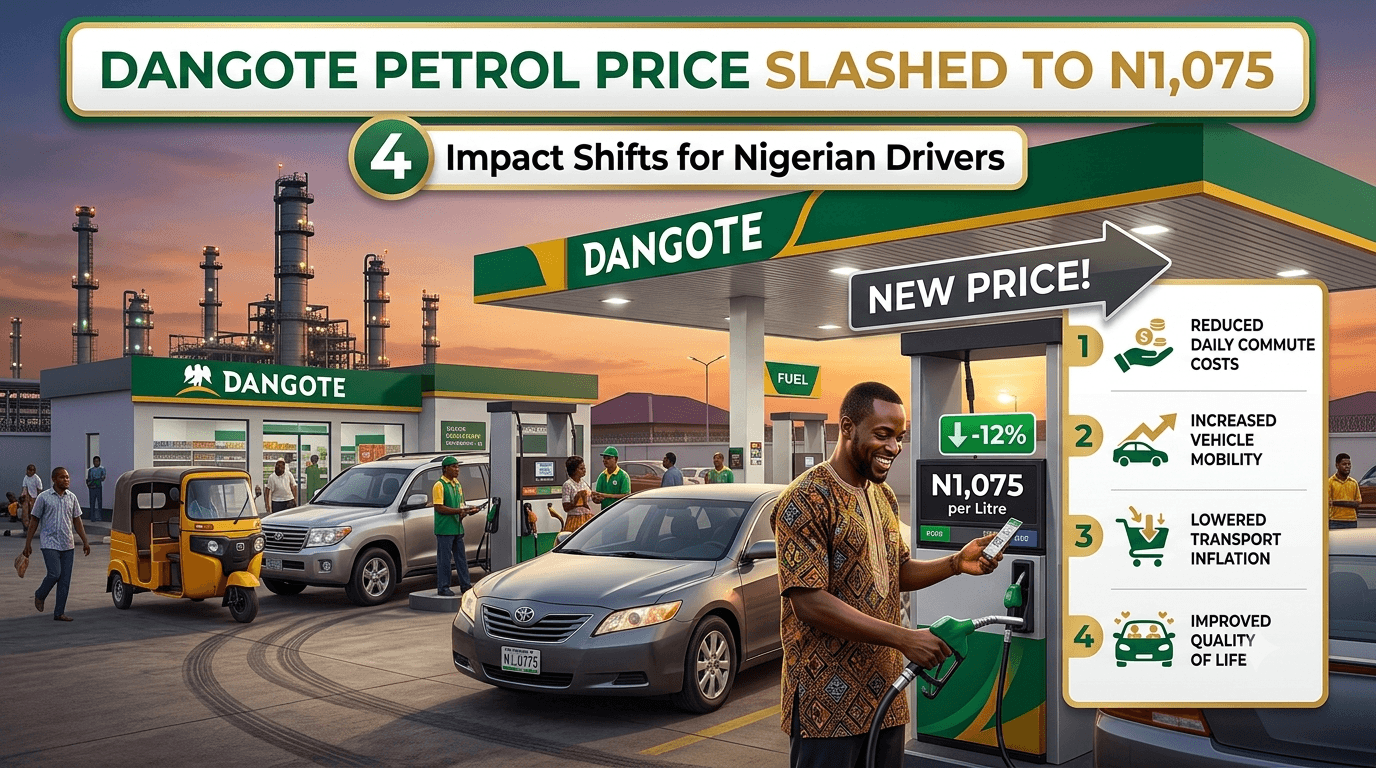
Looking for updates on the Dangote petrol price? The refinery just slashed prices to N1,075. Discover 4 ways this impacts fuel pump prices today.
The recent adjustment of the Dangote petrol price to N1,075 marks a pivotal moment for millions of motorists across Nigeria. After months of navigating volatile fuel costs, this reduction offers a much-needed sense of relief for families and businesses alike.

This shift is not just about lower numbers at the pump. It represents a fundamental change in how we manage our daily commutes and household budgets. By stabilizing fuel expenses, the new Dangote petrol price creates a foundation for better economic planning.
In this article, we will explore four critical shifts resulting from this change. We will examine how this adjustment impacts your wallet, influences market stability, and changes the way you approach your daily travel needs.
Key Takeaways
- The reduction to N1,075 provides immediate financial relief for Nigerian drivers.
- Lower fuel costs help stabilize household budgets against inflation.
- Improved affordability encourages more efficient daily commuting patterns.
- Market stability is expected to grow as fuel supply chains normalize.
- This change serves as a vital turning point for the national economy.
Understanding the New Dangote Petrol Price Benchmark
The N1,075 price benchmark is more than just a number; it is a signal of changing dynamics in the domestic oil market. This adjustment reflects a broader petroleum pricing analysis that accounts for the transition from reliance on imported products to local manufacturing. By setting this rate, the industry aims to create a more predictable environment for stakeholders across the country.
The Shift in Domestic Refining Dynamics
For years, the volatility of fuel prices in nigeria was largely tied to the complexities of international supply chains and foreign exchange fluctuations. The emergence of the Dangote Refinery changes this narrative by localizing the production process. This shift allows for a more streamlined supply chain that reduces the overhead costs associated with importing refined products.
By producing fuel domestically, the refinery helps mitigate the impact of global market shocks on the local economy. This transition is essential for establishing a sustainable dangote petrol price that reflects local production realities rather than external pressures. Efficiency in local refining serves as the backbone for long-term price stability.
Market Reactions to the N1,075 Price Point
The introduction of the N1,075 price point has triggered varied responses from both consumers and independent retailers. While the market adjusts to this new baseline, stakeholders are closely monitoring how this change influences daily operations. A thorough petroleum pricing analysis suggests that the market is moving toward a more transparent and competitive structure.
Key observations regarding the current market environment include:
- Increased predictability for independent marketers planning their inventory.
- A gradual stabilization of fuel prices in nigeria as supply chains become more localized.
- Heightened consumer awareness regarding the benefits of domestic refining for the national economy.
Ultimately, the dangote petrol price represents a critical step toward energy independence. As the market continues to adapt, the focus remains on maintaining a balance that supports both the viability of the refinery and the purchasing power of the average Nigerian citizen.
Economic Implications for the Nigerian Transportation Sector
The recent adjustment in the dangote petrol price is fundamentally reshaping the landscape for Nigeria’s transport sector. By lowering the cost of fuel, the government and the refinery are providing a necessary buffer for commercial operators who have long struggled with volatile overheads.
This shift allows for a more predictable petroleum pricing analysis, enabling businesses to plan their budgets with greater confidence. As fuel represents the largest variable cost for most transport companies, this change acts as a catalyst for broader economic stabilization.
Reducing Operational Costs for Commercial Transporters
Commercial transporters are the backbone of the Nigerian economy, moving millions of people and goods daily. When fuel prices drop, these operators can finally breathe easier, as their daily expenditure on diesel and petrol decreases significantly.
This reduction in overheads is crucial for maintaining stable fare structures for the average commuter. Instead of constantly raising prices to cover rising fuel costs, operators can now focus on fleet maintenance and service quality.
“Affordable fuel is the lifeblood of our transport network; when prices stabilize, the entire economy moves forward with renewed efficiency.”
— Industry Logistics Analyst
Impact on Logistics and Supply Chain Efficiency
The efficiency of the national supply chain is directly tied to the cost of moving goods from ports to inland markets. A lower fuel price helps logistics companies optimize their routes and reduce the final cost of consumer goods.
By lowering the barrier to entry for transport services, the current petroleum pricing analysis encourages more competition among logistics providers. This competitive environment ultimately benefits the end consumer through reduced inflationary pressure on essential items.
| Cost Factor | Pre-Adjustment | Post-Adjustment |
|---|---|---|
| Fuel Expenditure | High/Volatile | Moderate/Stable |
| Operational Margin | Narrow | Improved |
| Fare Stability | Frequent Hikes | Predictable |
| Logistics Speed | Delayed | Optimized |
In summary, the dangote petrol price reduction serves as a vital tool for economic recovery. It empowers transporters to maintain their operations while keeping the cost of living more manageable for all Nigerians.
Analyzing the Dangote Refinery Production Capacity
Nigeria is witnessing a transformative era in fuel processing thanks to the advanced capabilities of the dangote refinery. This facility serves as a cornerstone for national energy security by shifting the country away from a heavy reliance on international imports. By optimizing local operations, the nigeria fuel industry is finally positioned to meet the massive energy demands of its growing population.
Scaling Output to Meet National Demand
The primary objective of the dangote refinery is to ensure a consistent and reliable supply of petroleum products across the nation. Scaling production to meet domestic needs requires a sophisticated logistics network and high-volume processing capabilities. By prioritizing local output, the facility effectively reduces the volatility often associated with global market fluctuations.
This strategic focus on domestic supply helps stabilize the nigeria fuel industry by minimizing the logistical hurdles of importing refined products. When production reaches its full potential, the country can maintain a steady inventory to support both commercial and private transportation sectors. This transition is essential for long-term economic stability and energy independence.
Technological Advancements in Local Fuel Processing
Modern technology plays a vital role in the efficiency of the dangote refinery. The integration of state-of-the-art processing units allows for higher yields and superior fuel quality compared to older, traditional methods. These advancements ensure that the final product meets international standards while remaining cost-effective for the local market.
The following table highlights the key differences between the traditional import-dependent model and the new local refining approach:
| Feature | Import-Dependent Model | Local Refining (Dangote) |
|---|---|---|
| Supply Reliability | Low (Subject to global delays) | High (Domestic control) |
| Cost Structure | High (Includes shipping/fees) | Optimized (Reduced overhead) |
| Quality Control | Variable | Consistent/High Standard |
| Economic Impact | Capital Flight | Job Creation/Growth |
By leveraging these technological improvements, the facility ensures that every barrel processed contributes to a more robust energy infrastructure. This commitment to innovation is what makes the refinery a vital asset for the future of the nation.
Shifts in Household Budgeting and Disposable Income
A thorough petroleum pricing analysis reveals that lower fuel costs directly translate into increased financial freedom for the average citizen. When the cost of energy drops, the immediate effect is a noticeable rise in disposable income for families across Nigeria. This shift allows households to redirect funds that were previously consumed by high transportation expenses toward other vital areas of life.

Adjusting Monthly Expenditure for Commuters
Commuters who rely on public transport or personal vehicles are now in a position to restructure their monthly budgets. By tracking the reduced daily costs, individuals can create a more efficient financial plan that accounts for these savings. It is wise to set aside the difference in fuel costs immediately rather than absorbing it into general spending.
Many commuters are finding that even small daily savings accumulate into significant monthly totals. This extra capital can be used to settle outstanding utility bills or to increase monthly savings contributions. Strategic budgeting during this period of price stability is essential for long-term financial health.
Long-term Savings Potential for Private Vehicle Owners
Private vehicle owners stand to gain the most from this petroleum pricing analysis as they manage their own fuel consumption directly. By maintaining their vehicles properly, owners can maximize the benefits of lower prices and extend the life of their engines. This proactive approach ensures that the savings are not lost to unnecessary repairs or poor fuel efficiency.
The ability to allocate funds previously spent on fuel toward long-term investments is a major advantage for families. Whether these funds go toward education, home improvements, or emergency savings, the impact on household stability is profound. Consistent monitoring of fuel expenses will help owners maintain this positive momentum in their personal finances.
Competitive Landscape of the Nigerian Oil Industry
Recent shifts in the nigeria fuel industry have forced independent marketers to rethink their traditional business models. As the market adapts to new pricing benchmarks, these stakeholders are finding innovative ways to remain profitable while navigating a changing economic environment.
How Independent Marketers Are Responding
Independent marketers are currently restructuring their operations to stay competitive in this evolving landscape. Many are focusing on operational efficiency to reduce overhead costs, which allows them to pass significant savings directly to the Nigerian public.
By streamlining supply chains and optimizing distribution routes, these businesses are proving that they can thrive even under tighter margins. This proactive approach ensures that consumers have access to fuel at more affordable rates across various retail outlets.
“True competition in the energy sector is not just about price; it is about creating a sustainable ecosystem where both the provider and the consumer find value.”
The Role of Regulatory Oversight in Pricing Stability
Government agencies play a vital role in maintaining order within the oil industry news cycle. By implementing strict monitoring frameworks, regulators ensure that pricing remains consistent and fair for all citizens, preventing predatory practices.
These oversight mechanisms are essential for fostering a balanced market where healthy competition can flourish. When agencies enforce transparency, it builds consumer trust and encourages long-term stability across the entire supply chain.
Ultimately, the synergy between private enterprise and effective regulation is what defines the current state of the sector. Staying informed on the latest oil industry news remains crucial for stakeholders who wish to navigate this dynamic environment successfully.
Macroeconomic Effects on Inflation and Consumer Goods
Fluctuations in fuel prices in Nigeria serve as a primary driver for broader inflationary trends across the nation. When energy costs rise, the entire supply chain experiences immediate pressure, leading to higher prices for the average consumer. This dynamic highlights how energy policy acts as a cornerstone for national economic health.
Correlation Between Fuel Costs and Food Prices
The cost of transporting agricultural produce from rural farms to urban markets is heavily dependent on petroleum products. As logistics expenses climb, farmers and distributors pass these costs onto the final buyer, directly inflating the price of essential food items. This creates a direct link between the pump price and the household grocery bill.
Recent oil market trends suggest that stabilizing energy costs can provide much-needed relief to the food sector. By lowering the overhead for commercial transporters, the government can help dampen the inflationary pressure on basic commodities. This strategy is essential for protecting the purchasing power of low-income families.
“Energy security is the bedrock of economic stability; when we produce our own fuel, we insulate our citizens from the volatility of global markets.”
— Economic Policy Analyst
Stabilizing the Naira Through Reduced Import Dependency
Reliance on imported petroleum products has historically placed immense strain on the nation’s foreign exchange reserves. By shifting toward local refining, the country significantly reduces the demand for foreign currency needed to settle import bills. This transition is a critical step in strengthening the Naira against major global currencies.
Lowering import dependency creates a more predictable economic environment for businesses and investors. When the demand for foreign exchange for fuel imports drops, the central bank can better manage currency fluctuations. The following table illustrates how these shifts impact various sectors of the economy.
| Economic Sector | Impact of High Fuel Costs | Benefit of Local Refining |
|---|---|---|
| Agriculture | High transport overhead | Lower logistics costs |
| Manufacturing | Increased production expenses | Stable energy supply |
| Retail | Reduced consumer spending | Increased disposable income |
Ultimately, the move toward domestic production is not just about energy; it is a strategic macroeconomic maneuver. By aligning oil market trends with local capacity, the nation can foster sustainable growth. This approach ensures that the benefits of local resources are felt directly by the citizens in their daily lives.
Infrastructure Challenges and Distribution Logistics
Addressing logistical bottlenecks is the next critical step in stabilizing the domestic energy supply chain. While production capacity grows, the ability to move products efficiently dictates the health of current oil market trends. Without a seamless delivery system, the benefits of local refining may not reach every corner of the country.
Overcoming Bottlenecks in Fuel Delivery
The nigeria fuel industry faces significant hurdles when transporting petroleum from coastal refineries to inland states. Many remote regions currently experience supply delays due to reliance on a limited number of transport methods. Diversifying the distribution network is essential to ensure that fuel reaches consumers without unnecessary price hikes caused by scarcity.
Strategic investments in storage facilities near major consumption hubs can help mitigate these delays. By creating regional reserves, distributors can maintain a steady flow of products even when primary transport routes face temporary closures. This approach reduces the pressure on the existing supply chain and improves overall market reliability.
The Importance of Pipeline and Road Network Integrity
Maintaining the physical integrity of pipelines and road networks is vital for long-term energy security. Deteriorating infrastructure often leads to frequent disruptions, which negatively impact the consistency of oil and gas updates across the nation. Regular maintenance schedules are required to prevent leaks and structural failures that halt distribution.
Furthermore, the reliance on road transport for fuel delivery places immense strain on highways. Upgrading these roads is not just a matter of convenience but a fundamental requirement for economic stability. Investing in pipeline security and road rehabilitation will ultimately lower the cost of logistics, ensuring that fuel remains affordable for all Nigerians.
Future Outlook for Energy Sector Updates in Nigeria
Looking ahead, the trajectory of the energy sector in Nigeria suggests a move toward greater market maturity and sustainability. As the nation stabilizes its domestic refining capacity, stakeholders are closely monitoring energy sector updates to understand how future market shifts will impact the broader economy.

Anticipating Further Price Adjustments
The market for petroleum products is expected to remain dynamic as local production scales up. While recent changes have provided a new benchmark, experts suggest that fuel prices in nigeria will likely fluctuate based on global crude oil trends and local distribution efficiency.
Maintaining price stability remains a top priority for regulators and industry leaders. By reducing reliance on imported refined products, the country aims to create a more predictable pricing environment for both businesses and private consumers. These oil and gas updates are essential for long-term financial planning across all sectors.
Strategic Investments in Renewable Energy Alternatives
Beyond traditional petroleum, Nigeria is beginning to integrate renewable energy alternatives into its national power strategy. This transition is vital for meeting global sustainability standards while diversifying the energy mix. Investors are increasingly looking at solar and wind projects to complement existing infrastructure.
Strategic investments in these green technologies will likely reduce the long-term pressure on fuel prices in nigeria. By adopting a hybrid approach, the nation can ensure energy security while fostering innovation. Staying informed on the latest oil and gas updates will help stakeholders navigate this evolving landscape effectively.
Government Policy and the Dangote Group News
Recent developments surrounding the dangote group news highlight the transformative power of collaborative governance in the oil industry. The success of large-scale industrial projects depends on a stable environment where policy and private ambition align. By fostering this synergy, the government ensures that the energy sector updates remain positive for the national economy.
Public-Private Partnerships in Energy Security
Public-private partnerships serve as the backbone for achieving true energy security in Nigeria. These collaborations allow the state to leverage private capital and technical expertise to modernize infrastructure. When the government works closely with entities like the dangote refinery, it creates a reliable pathway to reduce the country’s heavy reliance on imported fuel.
“The strength of a nation’s energy sector is measured by its ability to turn local resources into national prosperity through strategic cooperation.”
This partnership model is essential for stabilizing supply chains across the country. It encourages long-term investment, which is vital for maintaining consistent fuel availability. Such cooperation is a recurring theme in current oil industry news, signaling a shift toward self-sufficiency.
Legislative Frameworks Supporting Local Refining
Legislative support provides the necessary foundation for the growth of local refining capacity. By implementing policies that favor domestic production, the government incentivizes companies to expand their operations. These frameworks are designed to protect local interests while ensuring that the dangote refinery can operate at its full potential.
Clear regulations help mitigate risks for investors, making the energy sector updates more predictable and attractive. As the government continues to refine these laws, the oil industry news reflects a growing confidence in Nigeria’s industrial future. Strengthening these legal structures remains a top priority for sustainable economic development.
Conclusion
The adjustment of fuel prices marks a pivotal moment for the national economy. This shift highlights the growing influence of the dangote refinery on local market stability. Drivers and business owners now face a landscape defined by reduced import reliance.
Staying informed remains vital as the oil industry news continues to evolve. Regular energy sector updates provide the clarity needed to navigate these changing costs. Smart planning helps individuals and companies adapt to these price benchmarks effectively.
The latest dangote group news reflects a broader commitment to national self-sufficiency. Consistent monitoring of oil and gas updates ensures that stakeholders remain prepared for future market fluctuations. This transformation supports long-term growth for the entire country.
Engage with these developments to make better financial decisions for your household or business. Keep track of official announcements to understand how local production shapes your daily expenses. A stable energy future depends on collective awareness and proactive participation in this new economic reality.
FAQ
What is the significance of the new N1,075 dangote petrol price for Nigerian consumers?
The reduction of the dangote petrol price to N1,075 per liter represents a pivotal shift in the nigeria fuel industry. This benchmark provides immediate financial relief to millions of motorists and commercial transporters, signaling a move toward greater affordability and market stability as the country reduces its reliance on expensive imported fuel.
How does the dangote refinery influence the stability of fuel prices in nigeria?
The dangote refinery stabilizes fuel prices in nigeria by transitioning the market from an import-dependent model to one driven by domestic refining. By processing crude oil locally, the refinery eliminates international freight costs and middleman margins, allowing for a more predictable pricing structure that is less vulnerable to volatile global oil market trends.
What impact will this price adjustment have on the transportation and logistics sectors?
According to recent petroleum pricing analysis, the lower fuel cost significantly reduces operational overhead for commercial drivers and logistics companies. This shift enhances supply chain efficiency and helps lower the cost of moving goods across the country, which is expected to ease the inflationary pressure on transport fares and consumer products.
Can the dangote refinery production capacity meet the total energy demand of Nigeria?
Yes, with a processing capacity of 650,000 barrels per day, the dangote refinery is designed to scale its output to meet and eventually exceed national demand. By utilizing advanced technological processing, the facility ensures a consistent supply of high-quality petroleum products, which is a cornerstone of recent dangote group news regarding national energy security.
How does the reduction in fuel costs affect household budgeting and disposable income?
Lowering the price to N1,075 allows households to reallocate funds that were previously consumed by high commuting costs. This increase in disposable income enables families to spend more on essential needs such as food and healthcare, creating a positive ripple effect throughout the broader Nigerian economy.
How are independent marketers and the wider oil industry news responding to this change?
The latest oil industry news indicates that independent marketers are restructuring their business models to remain competitive under the new pricing regime. Regulatory bodies are also playing a vital role in ensuring that the N1,075 price point is implemented fairly across retail outlets, fostering a healthier competitive landscape within the nigeria fuel industry.
What are the macroeconomic benefits of domestic refining for the Naira?
Domestic refining through the dangote refinery helps stabilize the Naira by significantly reducing the demand for foreign exchange typically required for fuel imports. This reduction in import dependency is a critical factor in current energy sector updates, as it helps the Central Bank of Nigeria manage liquidity and support the local currency’s value.
What infrastructure challenges must be addressed to optimize fuel distribution?
To fully realize the benefits of the new dangote petrol price, Nigeria must address bottlenecks in distribution logistics, including the integrity of the road network and pipeline systems. Ensuring efficient delivery to remote regions is essential for maintaining a uniform price and preventing localized fuel scarcities.
What is the future outlook for the Nigerian energy sector regarding further price adjustments?
Future oil and gas updates suggest that as the refinery reaches full operational optimization, further price adjustments may be possible. Additionally, the industry is looking toward integrating renewable energy alternatives alongside traditional petroleum to meet long-term sustainability goals and global energy standards.
How do government policies and public-private partnerships support these energy sector updates?
The Nigerian government has implemented legislative frameworks that encourage local refining and support massive private investments like those seen in the dangote group news. These public-private partnerships are essential for achieving long-term energy sovereignty and ensuring that the country’s energy infrastructure can support robust economic growth.
Disclaimer
This article is published for informational and educational purposes only and should not be considered financial, investment, or professional advice. The information regarding Dangote Refinery’s petrol pricing, fuel market developments, and their potential impact on Nigerian drivers is based on publicly available reports and official announcements available at the time of publication. Petrol prices, government policies, distribution costs, and market conditions may change without notice. Readers are encouraged to verify the latest pricing information through official sources and make personal or business decisions based on current market conditions. DailyEdge360 is not affiliated with, endorsed by, or acting on behalf of Dangote Refinery, the Nigerian National Petroleum Company (NNPC), or any government agency mentioned in this article.