
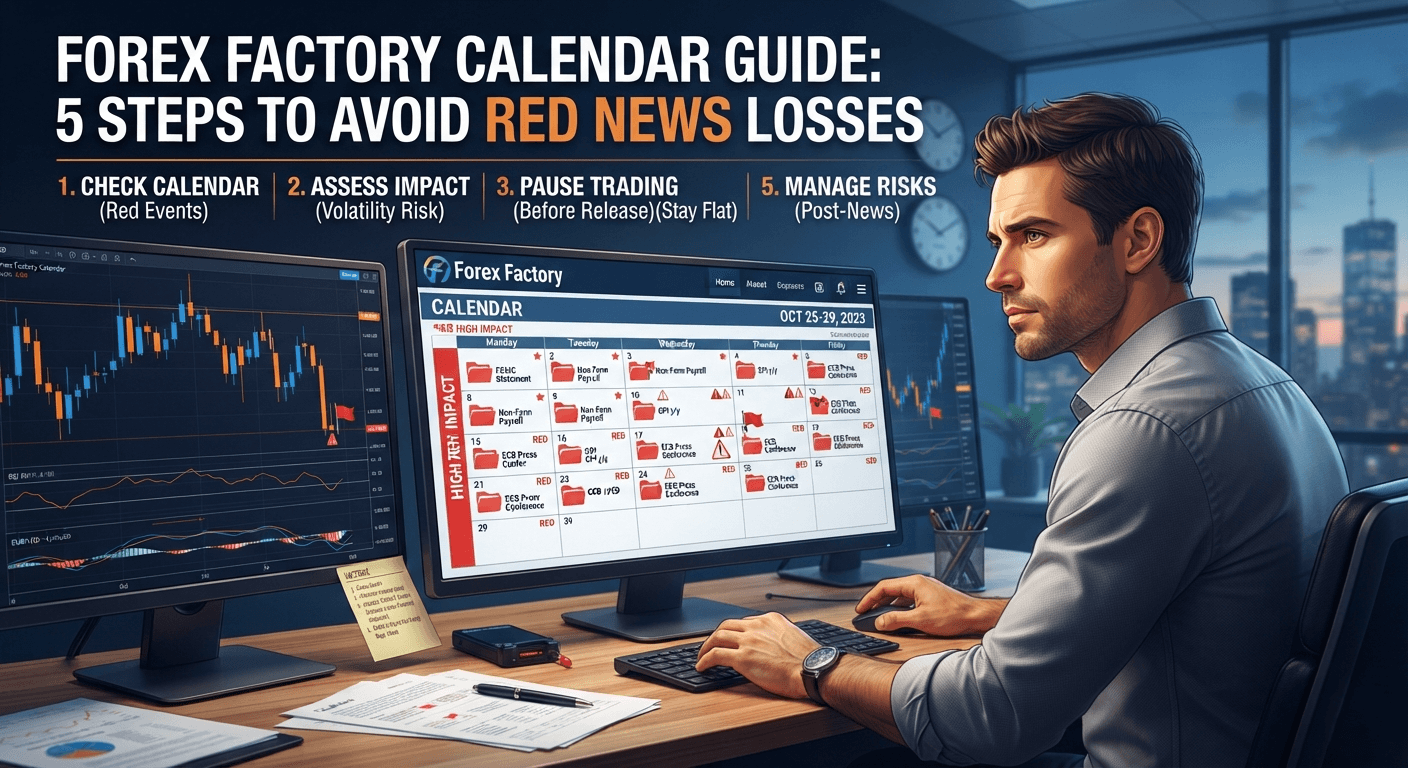
Learn how to use the Forex Factory calendar guide to set your local time zone, filter red news, and protect your trades from high market volatility.
Navigating the volatile landscape of global markets requires more than just technical analysis. For traders based in the United States, sudden price swings during high-impact economic releases can wipe out accounts in seconds. Utilizing a reliable Forex Factory Calendar Guide is the first step toward protecting your hard-earned capital from unexpected market shocks.
Many investors react to news events after the damage is already done. By adopting a proactive, data-driven strategy, you can anticipate these shifts rather than falling victim to them. This approach transforms how you view economic data, turning potential risks into manageable variables.

Our comprehensive forex calendar guide outlines a proven five-step framework designed to mitigate losses. Mastering these nuances allows you to trade with confidence, ensuring you stay ahead of the curve during even the most turbulent news cycles.
Key Takeaways
- Identify high-impact news events that trigger significant market volatility.
- Learn to align your trading positions with scheduled economic announcements.
- Implement strict risk management protocols before major reports are released.
- Transition from reactive decision-making to a structured, proactive strategy.
- Protect your trading capital by avoiding trades during high-risk windows.
Understanding the Impact of High-Impact News on Forex Markets
High-impact news events act as catalysts for rapid price movements that can catch unprepared traders off guard. When major economic data is released, the forex factory calendar serves as a vital tool for identifying these critical moments. These events often force the market to reprice assets in a matter of seconds.
Why Red Folder Events Trigger Market Volatility
Red folder events represent the highest level of economic significance. They typically involve data that directly influences central bank policy or national economic health, such as Non-Farm Payrolls or interest rate decisions.
When these reports hit the wires, liquidity providers often widen spreads to manage risk. This environment creates several challenges for active participants:
- Sudden Slippage: Orders may execute at prices far worse than expected.
- Increased Spreads: Transaction costs rise sharply during the initial spike.
- Directional Uncertainty: Price action often whipsaws before establishing a clear trend.
The Psychology of News-Driven Trading for US Traders
Navigating the markets during high-impact releases requires more than just technical skill; it demands emotional discipline. US traders often face immense pressure when major reports align with the opening of the New York session. Relying on a consistent forex news calendar helps mitigate the urge to make impulsive, fear-based decisions.
Traders who fail to prepare often fall victim to the “fear of missing out” or panic selling. Maintaining a professional mindset is essential when the forex factory calendar indicates high volatility ahead. By focusing on a pre-defined strategy, you can avoid the emotional traps that lead to unnecessary losses.
A well-configured dashboard is the secret weapon for any trader relying on a Forex Factory Calendar Guide. By tailoring the platform to your specific needs, you eliminate unnecessary noise and focus on the data that truly moves your bottom line. Mastering these settings is a fundamental step in building a professional trading routine.
Customizing Time Zones and Currency Filters
The first step in your setup is ensuring the forex economic calendar reflects your local time zone. Accurate timing is critical when you are tracking high-impact events that occur during specific market sessions. You can easily adjust this by clicking the time display at the top of the interface to match your local clock.
Next, use the filter icon to select only the currency pairs you actively trade. By deselecting irrelevant currencies, you prevent information overload and keep your focus sharp. This streamlined approach allows you to react faster when volatility spikes occur in your preferred markets.
Interpreting the Data Columns: Actual, Forecast, and Previous
Understanding the three primary data columns is essential for gauging market sentiment. The Actual figure represents the latest released data, while the Forecast shows what analysts expected. The Previous column provides the historical context from the last reporting period.
“The market does not move based on the news itself, but rather on the surprise factor between the actual data and the consensus forecast.”
— Professional Market Analyst
Use the following table to understand how these metrics interact to influence price action:
| Column Name | Definition | Market Impact |
|---|---|---|
| Actual | The latest released data point. | Determines immediate price direction. |
| Forecast | The consensus expectation. | Sets the baseline for market pricing. |
| Previous | The prior period’s result. | Provides a trend comparison. |
| Difference | Actual minus Forecast. | Drives volatility and momentum. |
By consistently monitoring these columns, you can better predict how the forex economic calendar will influence your trades. This level of preparation is what separates disciplined traders from those who simply guess at market movements.
Step One: Filtering for High-Impact Red Folder Events
To gain a competitive edge, you must learn to isolate the most critical market-moving events from the daily noise. Many novice traders feel overwhelmed by the sheer volume of data released every single day. By utilizing a professional forex event calendar, you can streamline your workflow and focus only on the events that truly matter.
Identifying the Red Folder Significance
The core of this strategy relies on the color-coded system used to categorize economic news. A red folder indicates an event with the highest potential for market volatility. These releases, such as Non-Farm Payrolls or interest rate decisions, often trigger rapid price swings that can either make or break a trade.
When you see a red folder on your forex factory calendar, it serves as an immediate signal to pay close attention. These events represent the pulse of the global economy. Prioritizing these specific indicators allows you to allocate your time and risk management resources where they are most needed.
Filtering Out Noise to Focus on Major Economic Indicators
Not every economic report requires your immediate reaction. Many low-impact events create unnecessary distractions that can lead to poor decision-making. You should use the filter settings to hide yellow and orange folders, which typically have a minimal impact on price action.
By clearing the clutter, you ensure that your forex factory calendar displays only the data points that move the needle. This disciplined approach helps you maintain a clear head during high-pressure sessions. Focusing on quality over quantity is the hallmark of a successful and professional trader.
Step Two: Analyzing Market Sentiment Before the Release
Evaluating the prevailing market bias is essential for any serious trader using a forex calendar guide. Before the economic data hits the wires, the market often displays a clear directional preference. Identifying this sentiment allows you to align your positions with the broader flow of capital.
Using Currency Strength Meters to Gauge Pre-News Bias
Currency strength meters serve as vital tools for visualizing which currencies are currently in favor. By observing these meters, you can determine if a specific currency is showing relative weakness or strength against its peers. This pre-news bias often dictates how the market will react to incoming economic reports.
When you consult your forex trading calendar, look for correlations between the strength meter and the upcoming event. If a currency is already trending strongly, a positive news release might trigger a continuation rather than a reversal. Understanding this momentum is key to avoiding premature entries.
Evaluating Consensus Forecasts vs. Market Expectations
The numbers displayed on your screen are only half the story. You must compare the official consensus forecasts against the actual market expectations to spot hidden opportunities. Often, the market has already “priced in” a specific outcome, meaning the real volatility occurs only when the actual data deviates from these expectations.
Professional traders look for discrepancies between what analysts predict and how the price is currently behaving. If the market is ignoring a bearish forecast, it may signal that institutional players are positioning for a surprise. Using a reliable forex trading calendar helps you track these shifts in sentiment, ensuring you are never caught off guard by unexpected market moves.
Step Three: Implementing Pre-News Risk Management Protocols
Protecting your trading account during major economic releases is not optional; it is a fundamental requirement. When you consult your forex trading calendar, you are essentially identifying windows of high risk. Professional traders know that survival in the market depends on how well they prepare for these moments of extreme volatility.
Adjusting Position Sizing Ahead of Volatile Releases
Market conditions often shift rapidly when high-impact data is released. To maintain stability, you should always consider reducing your standard position size before a major announcement. Smaller positions allow your account to withstand sudden price swings without triggering a margin call.
By lowering your exposure, you gain the flexibility to stay in the trade even if the initial reaction is erratic. This strategy ensures that a single news event does not wipe out your hard-earned gains. Consistency is far more valuable than chasing a massive win during a period of high uncertainty.
Setting Stop-Loss Orders to Protect Against Slippage
Slippage is a common reality during news events when liquidity dries up momentarily. When the market moves faster than your broker can execute, your stop-loss might be filled at a worse price than intended. Using a forex market calendar helps you anticipate these periods so you can plan your exits accordingly.
To mitigate these risks, consider the following essential safety measures:
- Avoid placing orders directly on top of major support or resistance levels where liquidity is often thin.
- Use wider stop-loss distances to account for the expected volatility of the specific news release.
- Consider closing positions entirely if you are uncomfortable with the potential for rapid price gaps.
- Always verify that your broker provides reliable execution during high-impact events.
Implementing these protocols creates a safety net for your capital. By prioritizing risk management, you transform the forex market calendar from a source of anxiety into a powerful tool for long-term growth.
Step Four: Executing Trades During High Volatility Windows
Executing trades during high volatility windows requires a blend of discipline and rapid decision-making. Once the data from your forex market calendar hits the wire, the market often experiences a sudden surge in price movement. This period demands that you remain calm and stick to your pre-planned risk parameters.

Strategies for Trading the Initial News Spike
Aggressive traders often look to capitalize on the immediate momentum generated by a major announcement. This approach involves entering the market the moment the data is released to capture the initial price spike. You must ensure your execution speed is high to avoid slippage during these fast-moving conditions.
Successful execution here relies heavily on your prior forex calendar analysis. By knowing the expected deviation between the forecast and the actual result, you can anticipate the direction of the move. Quick entry and tight stop-losses are essential to protect your capital if the market suddenly reverses.
Waiting for Market Consolidation After the News Break
Conservative traders often prefer to wait for the initial chaos to subside before entering a position. This strategy focuses on identifying a consolidation phase where the market finds a temporary equilibrium. By waiting, you avoid the whipsaw price action that frequently traps impulsive participants.
Once the volatility settles, look for clear technical patterns that confirm the new trend direction. This method allows for more precise entry points and better risk-to-reward ratios. Consistent forex calendar analysis helps you determine if the post-news move has enough fundamental backing to sustain a longer-term trend, rather than just a temporary reaction.
Step Five: Reviewing Post-News Performance and Adjusting Strategy
Once the dust settles after a major economic release, your work as a professional trader is only just beginning. Many market participants focus entirely on the entry, but the most successful individuals understand that post-trade reflection is the true engine of growth. By utilizing a forex trading calendar to track your history, you can turn every volatile session into a valuable lesson.
Documenting Trade Outcomes in Your Trading Journal
A detailed trading journal serves as your personal roadmap to consistency. You should record not only the entry and exit prices but also the specific news event that triggered the move. Capturing your emotional state during the trade is equally important, as it helps you identify if fear or greed influenced your decision-making process.
- Entry and Exit timestamps relative to the news release.
- The specific economic indicator that caused the volatility.
- Your psychological state before and after the trade execution.
- The final profit or loss outcome in pips or dollars.
Refining Your Approach Based on Historical News Reactions
Effective forex calendar analysis requires you to look for recurring patterns in how the market reacts to specific data points. Over time, you may notice that certain currency pairs respond more aggressively to specific reports, such as Non-Farm Payrolls or interest rate decisions. Use the following table to categorize your performance and identify areas for improvement.
| News Event | Expected Outcome | Actual Result | Strategy Success |
|---|---|---|---|
| Interest Rate | Bullish | Neutral | Low |
| CPI Data | Bearish | Bearish | High |
| GDP Report | Bullish | Bullish | Medium |
By reviewing these historical reactions, you can adjust your risk management protocols to better suit current market conditions. Adaptability is the hallmark of a seasoned trader. When you consistently refine your strategy, you move away from relying on luck and toward a data-driven approach that stands the test of time.
Common Pitfalls When Using the Forex Economic Calendar
Navigating the markets requires more than just watching a forex economic calendar; it requires avoiding common mistakes. Many traders assume that every scheduled event offers a profitable opportunity. However, failing to recognize the nuances of market timing often leads to unnecessary frustration and capital erosion.
Over-Trading During Low-Liquidity News Events
One of the most frequent errors involves entering positions during periods of low market liquidity. When a forex news calendar lists minor events, institutional participation often drops significantly. This lack of volume can cause wider spreads and unpredictable price slippage.
Traders who force trades during these quiet windows often face higher transaction costs that eat into their margins. It is essential to remain patient and wait for high-impact sessions where liquidity is sufficient to support your technical setups. Over-trading in thin markets rarely results in consistent gains.
Ignoring the Impact of Secondary Economic Data
Some market participants focus exclusively on top-tier releases while ignoring secondary economic data. This narrow approach creates a skewed understanding of the broader economic environment. Secondary reports often provide the context needed to interpret major trends correctly.
By dismissing these smaller indicators, you might miss early warning signs of a shift in market sentiment. A disciplined trader uses a comprehensive forex news calendar to monitor the full spectrum of data. This holistic view helps in making informed decisions rather than reacting to isolated spikes.
| Data Type | Market Impact | Trading Strategy |
|---|---|---|
| High-Impact (Red) | Extreme Volatility | Risk Management Focus |
| Secondary Data | Trend Confirmation | Contextual Analysis |
| Low-Liquidity Events | Minimal Movement | Avoid Trading |
Advanced Techniques for Forex Calendar Analysis
Sophisticated traders utilize specific analytical methods to gain an edge during high-impact news events. Once you have mastered the basics of a Forex Factory Calendar Guide, you can begin to look for deeper market signals. These advanced strategies help you filter out noise and focus on high-probability setups.

Correlating Multiple Currency Pairs During Major Releases
Professional traders rarely look at a single currency pair in isolation when a major news event occurs. Instead, they monitor correlated assets to confirm the strength or weakness of a specific currency. For example, if the US Dollar is reacting to a major report, you should observe how both EUR/USD and USD/CHF move simultaneously.
If the data suggests a bullish move for the dollar, you should see a decline in EUR/USD alongside a rise in USD/CHF. Consistent movement across correlated pairs provides much higher confidence than relying on a single chart. This cross-pair validation is a cornerstone of effective forex calendar analysis.
Identifying Divergence Between Forecasts and Actual Data
A common mistake is assuming that the market always reacts linearly to news. Experienced participants look for divergence between the consensus forecast and the actual data released on your forex economic calendar. When the actual result significantly beats or misses expectations, the market often experiences a sharp, impulsive reaction.
However, you must also watch for instances where the news is “priced in” by the market beforehand. If the actual data matches the forecast perfectly, volatility might be lower than expected. Identifying these discrepancies allows you to anticipate whether a news release will trigger a massive breakout or a period of consolidation.
Integrating Technical Analysis with Fundamental News Data
Integrating technical analysis with fundamental news data transforms how you interpret market volatility. While a forex market calendar provides the “what” and “when” of economic events, technical charts reveal the “where” regarding price reaction. This dual approach allows you to filter out market noise and focus on high-probability setups.
Using Support and Resistance Levels During News Spikes
During high-impact news releases, price often gravitates toward established support and resistance levels. These zones act as magnets for liquidity, drawing price in before a potential breakout or rejection. By performing thorough forex calendar analysis before the news hits, you can identify these critical price barriers on your charts.
When price approaches a major resistance level during a news spike, it often struggles to break through immediately. Traders should watch for signs of exhaustion at these levels rather than blindly chasing the move. Strong support levels can provide a safety net, helping you determine where to place stop-loss orders to minimize risk during sudden market swings.
Applying Candlestick Patterns to Confirm News-Driven Trends
Candlestick patterns serve as the final confirmation tool when news data hits the wire. A sudden spike might look like a breakout, but a long wick on a candle often signals a false move or a potential reversal. You must wait for the candle to close to see if the market truly respects the new fundamental reality.
Look for patterns like engulfing candles or pin bars near key technical levels to gauge the strength of the news reaction. If a bullish news event occurs but the price fails to break resistance, a bearish reversal pattern suggests the market has already priced in the data. Combining these visual cues with your economic schedule ensures you are not caught on the wrong side of a volatile trend.
Tools and Resources to Complement Your Forex Event Calendar
While a forex factory calendar serves as a foundational element for many traders, relying on a single source can sometimes limit your market perspective. Integrating supplementary tools allows you to cross-reference data and react with greater precision. By building a robust information ecosystem, you ensure that your decision-making process remains sharp and well-informed.
Utilizing Real-Time News Feeds for Faster Execution
In the fast-paced world of currency trading, speed is often the difference between a profitable entry and a missed opportunity. Real-time news feeds provide instantaneous updates that hit your screen seconds before they appear on standard public portals. This latency advantage is crucial when high-impact data releases trigger sudden price spikes.
By subscribing to a professional forex news calendar or a dedicated wire service, you gain access to breaking headlines that move the markets. These feeds often include expert commentary that helps you interpret complex data points in real time. Faster execution becomes a reality when you are not waiting for delayed page refreshes.
Leveraging Broker-Specific Economic Calendars
Many top-tier brokers now offer proprietary tools that integrate directly into your trading platform. Using a broker-specific forex event calendar provides the unique benefit of seeing how specific economic events correlate with your broker’s liquidity and spreads. This alignment helps you avoid the common trap of trading during periods of artificially widened spreads.
These integrated tools often feature customizable alerts that notify you directly on your charts. Because the data is linked to your account, you can often execute trades with a single click immediately after reviewing the news. Leveraging these resources creates a seamless workflow that minimizes the time between analysis and action.
Conclusion
Successful trading requires a blend of preparation and disciplined execution. This forex calendar guide provides the framework needed to navigate unpredictable market shifts with confidence. By following these five steps, you gain a clearer view of how economic data influences price action.
Consistency remains the ultimate goal for every serious trader. Relying on a structured forex event calendar helps you avoid impulsive decisions during high-impact news releases. You protect your capital by prioritizing risk management and maintaining a clear focus on your long-term objectives.
Continuous learning sharpens your ability to interpret complex data sets. Each trade offers a chance to refine your strategy and improve your decision-making process. Stay committed to your plan and keep your emotions in check when the market moves rapidly.
Your journey toward profitability depends on your dedication to these core principles. Apply the insights from this guide to build a sustainable career in the financial markets. Start tracking your performance today to see how better preparation leads to better results.
FAQ
What does a red folder signify on the Forex Factory calendar?
In any professional forex calendar guide, a red folder indicates a high-impact economic event. These releases, such as the Non-Farm Payrolls (NFP) or Federal Reserve interest rate decisions, are expected to trigger significant market volatility. Traders use the Forex Factory calendar to identify these windows to either tighten their risk management or stay out of the market entirely to avoid capital erosion.
How can I customize the forex news calendar to match my local time?
To ensure your forex trading calendar is accurate, you must synchronize the time settings. On the Forex Factory interface, click on the time displayed at the top of the page. This allows you to select your specific time zone and toggle Daylight Savings Time settings. Precise timing is critical for executing trades the moment Actual data deviates from the Forecast.
Why is it important to distinguish between Actual, Forecast, and Previous data during forex calendar analysis?
These three columns are the backbone of forex calendar analysis. The Previous column shows the last recorded data point, while the Forecast represents the consensus among economists (often sourced from institutions like Bloomberg or Reuters). The Actual data is the real-time release. If the Actual figure differs significantly from the Forecast, it creates a “surprise” that drives the currency pair price movements.
What are the primary risks of trading during high-impact events on the forex market calendar?
The most significant risks identified in this forex calendar guide are slippage and spread widening. During a red news event, liquidity can thin out rapidly on platforms like MetaTrader 5 or OANDA, causing your stop-loss to be filled at a price much worse than intended. Managing these risks requires smaller position sizing and a deep understanding of the forex event calendar.
How can I filter the forex economic calendar to see only relevant currency pairs?
The Forex Factory calendar features a robust “Filter” tool located at the top right of the interface. You can deselect “Low Impact” (yellow) and “Medium Impact” (orange) folders to focus exclusively on red folder events. Additionally, you can filter by specific currencies—such as USD, EUR, or GBP—to ensure your forex news calendar only shows data that impacts your specific trading portfolio.
Can I combine technical analysis with the data found on a forex event calendar?
Absolutely. Professional traders often use support and resistance levels in conjunction with the forex market calendar. For example, if a high-impact news release occurs while a price is testing a major psychological level on a TradingView chart, the resulting news spike can provide the necessary momentum for a breakout or a sharp reversal.
What is a currency strength meter, and how does it relate to the forex trading calendar?
A currency strength meter is a visual tool that shows which currencies are trending or weakening in real-time. By using this tool alongside a forex economic calendar, you can identify market sentiment bias before a news release. For instance, if the USD is showing extreme strength leading up to a Retail Sales report, the market may have already “priced in” a positive result, leading to a “sell the news” reaction even if the data is good.
Why should traders wait for market consolidation after a major news release?
The initial “spike” following a release on the forex news calendar is often driven by high-frequency trading (HFT) algorithms and emotional reactions. Waiting for consolidation—where the price stabilizes into a range—allows the “smart money” to reveal the true direction of the trend. This patient approach is a cornerstone of any forex calendar guide aimed at long-term profitability.
What are the dangers of ignoring “secondary” data on the forex economic calendar?
While red folder events are the primary focus, ignoring secondary data (orange or yellow folders) can lead to a misunderstanding of the broader macroeconomic environment. Multiple medium-impact reports released simultaneously can have a cumulative effect similar to a single high-impact event, causing unexpected volatility that a simplified forex trading calendar view might miss.
How does a trading journal improve my use of the Forex Factory calendar?
Documenting your forex calendar analysis and the subsequent trade outcomes in a journal (like Edgewonk or Tradervue) helps identify patterns. By recording how specific pairs react to CPI or GDP releases over time, you can refine your strategy, learn to anticipate market reactions, and develop the discipline needed to avoid red news losses.
📱 Stay Connected: Follow us on X (Twitter) @Dailyedge360 and enable push notifications here for instant news alerts, live match tracking, and market updates!
Disclaimer:
Foreign exchange and financial market trading carry high risks and may not be suitable for all investors. The information in this guide is strictly for educational purposes and should not be considered financial or trading advice. Always trade responsibly and use appropriate risk management.








Hi~(* ̄▽ ̄*)
Honestly, it’s really good
I like this
An Engaging Blog Post
WOW,Very wonderful
The content is really great
That was amazing
Hi,how are you
Its Amazing