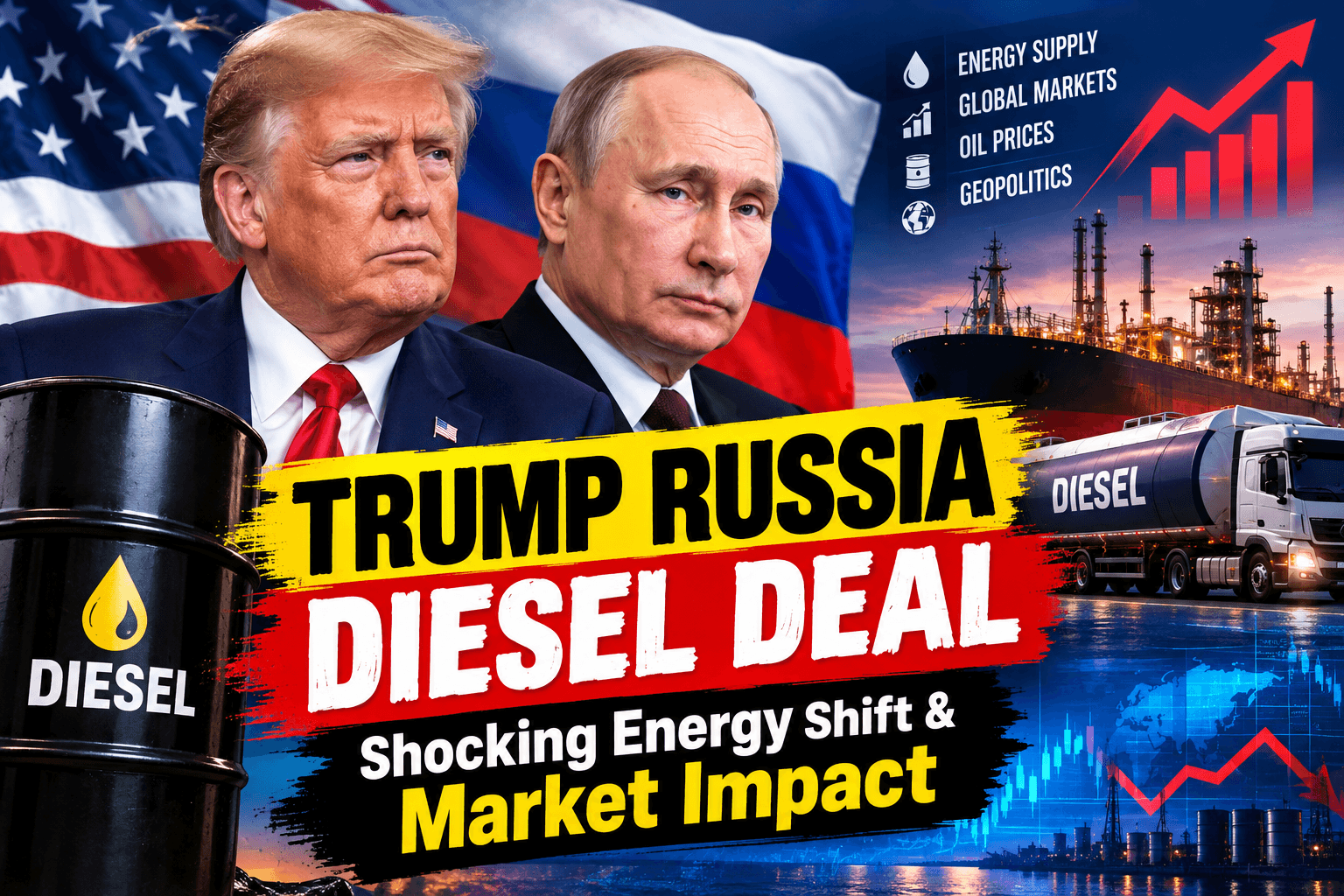
Breaking global energy news! Discover the details of the Trump Russia diesel deal as massive fuel shipments spark economic and regulatory debates.
Donald Trump has announced a reported Trump Russia Diesel Deal to bring Russian diesel into the US and wider markets. The move could affect energy costs, sanctions and support for Ukraine, but it does not confirm that any cargo has arrived or that prices will fall. For people in Britain, any effect on domestic fuel costs remains uncertain.
A temporary licence is a time-limited authorisation permitting specified Russian diesel sales despite otherwise applicable sanctions. The announcement comes during Russia’s war against Ukraine and amid pressure on fuel supplies. The practical consequences depend on whether the proposed supply is delivered and how markets respond. The terms set out the limits of what has been announced.

Key Takeaways
- The announcement describes proposed releases, not confirmed deliveries.
- A temporary licence permits specified Russian diesel sales for a limited period.
- Russia’s capacity to supply the announced amounts is not established.
- Any effect on American or British prices remains unknown.
- The UK government says it will maintain sanctions against Russia.
What the Trump Russia Diesel Deal Includes
The announcement sets out a timetable for proposed releases, not evidence that all the diesel has arrived. The announced amounts are commitments, not a confirmed total already delivered.
The schedule describes intended releases. It does not show that the diesel has reached buyers.
Trump made the announcement on Friday 9 October 2026. Its figures describe several tranches, with a separate condition attached to the largest further release.
The announced diesel tranches
Trump said 300,000 tonnes would be released immediately, followed by 500,000 tonnes in November and one million tonnes after that. He also referred to a further three million tonnes within a short period.
| Tranche | Announced amount | Timing | Stated condition |
|---|---|---|---|
| First | 300,000 tonnes | Immediate | None specified |
| Second | 500,000 tonnes | November | None specified |
| Third | One million tonnes | After that | None specified |
| Further | Three million tonnes | Within a short period | Refinery conditions |
The first three tranches have no separate condition stated in the announcement. The further three million tonnes depend on refinery conditions, which were not detailed.
What the temporary licence permits
The US Treasury issued a temporary licence allowing Russian diesel imports through 7 April. Other Russian assets, including assets in US banks, remain frozen. The permission covers specified sales, not a general end to sanctions. In answer to “How much diesel do we get from Russia?”, the figures are proposed commitments rather than confirmed deliveries. Putin confirmed willingness to supply oil and petroleum products, but gave no quantities. The terms now raise a separate question: why the White House chose to make the announcement amid political and energy pressure.
Why did Trump announce the deal now?
With November’s elections approaching, rising energy bills carry a political cost for Donald Trump. The Iran war and closure of the Strait of Hormuz have tightened energy supplies, putting pressure on motorists and the administration.
The war with Iran began in February 2026. Before the war, the Strait of Hormuz carried about 20% of global oil supplies. Its closure has disrupted a key route for energy shipments, intensifying concern about fuel prices. The proposed Russian supply offers a possible response, but does not show that prices will fall.
US midterm elections are congressional elections held halfway through a president’s four-year term. The November vote is approaching, and pressure on household fuel costs has become a public issue. Trump has also pursued other measures to ease that pressure:
- He considered suspending the federal gasoline tax.
- He allowed red-dyed diesel on US highways without federal tax.
- He pressed G7 countries to release 100 million barrels from stockpiles.
Trump had also supported a US diesel-export ban, a move that could keep more fuel at home. The range of measures shows how urgently the administration has sought to address costs, though each has different effects on supply and prices. The proposed Russian exports face a separate test: whether Russia can provide the product while managing its own fuel constraints.
Can Russia supply the promised diesel?
Russia has faced two waves of severe fuel shortages this year. Domestic pressure makes the export outlook difficult to judge, while refinery damage and an export ban complicate rapid, reliable deliveries.
Russian diesel production is estimated to have fallen by nearly 30%, but that figure does not show how much spare diesel Russia can export. Ukraine’s drone strikes on Russian oil refineries have contributed to the shortages, and Trump linked the attacks to rising fuel prices.

Russia introduced a diesel-export ban earlier in 2026. That policy and pressure on domestic supplies sit alongside the reported announcement of sales abroad. The ban complicates the prospect of quick exports, though it does not by itself establish whether the government can make exceptions or arrange supplies.
Refinery damage can limit the production and processing needed to make diesel available. The production estimate describes a decline, not the share of output set aside for domestic use or export. It therefore cannot confirm how much Russian oil and diesel may be available to overseas buyers.
Trump’s comments connect the refinery attacks with fuel prices, but that does not settle the supply question. Russia may meet some or all of the proposed schedule, or face constraints that delay it. Neither outcome is confirmed. The next question is separate from supply: even if shipments arrive, would they be large enough to change prices?
Will the deal lower American fuel prices?
US diesel averaged $6.28 (£4.74) a gallon, below its reported record of $6.52-$6.53. That comparison shows the pressure on consumers, but does not establish that the announcement caused a fall.
Average regular petrol was about $4.20 (£3.17) a gallon. Brent crude remained above $103 a barrel, compared with about $73 before the Iran war. Those figures reflect a wider energy market, not just the proposed Russian diesel sales.

The reported diesel record differs by one cent between accounts. The figures below show the range, alongside the current reported average and the petrol and oil comparisons.
| Measure | Figure | Unit | Timing or comparison |
|---|---|---|---|
| US diesel | $6.28 (£4.74) | Gallon | Current average |
| Diesel record | $6.52-$6.53 | Gallon | Reported high |
| Regular petrol | About $4.20 (£3.17) | Gallon | Average |
| Brent crude | Above $103; about $73 | Barrel | Now; before Iran war |
The first 300,000-tonne tranche equates to about 2.25 million barrels. US diesel consumption is about 3.8 million barrels a day, so that amount is less than one day’s use.
Tim Armitage of Quilter Cheviot called the announced quantities relatively small. He said the first tranche would not make a material difference to US pump prices. Even a delivered shipment would not, on its own, guarantee a particular change at the pump.
These figures describe US prices and cannot predict an equivalent change in Britain. The effect would depend on actual deliveries and wider market conditions. The price question is only one part of the debate, with the arrangement also raising diplomatic concerns about sanctions and support for Ukraine.
How does the deal affect Ukraine and US allies?
Volodymyr Zelenskyy’s central objection is that the arrangement could invest in a war that must be ended, not prolonged. For Ukraine, Russian export income matters because the country remains under attack.
The temporary licence appears at odds with a recently signed sanctions-and-tariffs framework, although Congress gave the president discretion to make exceptions. The legislation, signed by Trump, authorises sanctions and tariffs on countries importing Russian oil and gas.
Zelenskyy also said Ukraine’s strikes on Russian refineries respond to attacks on Ukrainian energy infrastructure. That is Ukraine’s stated rationale; the announcement itself does not establish an effect on the battlefield or prove how much money has reached Russia.
Criticism in the US has come from Democrats and Republicans. Their objections focus on the political signal and the possible support for Russia’s war effort:
- Zelenskyy warned that Russian income could prolong the war.
- US Democrats said the move undermines sanctions.
- Republican congressman Don Bacon called support for Putin’s war economy morally wrong.
The disagreement concerns both policy and the pressure placed on Moscow. It does not confirm that the proposed sales have generated revenue or changed military events. For Britain, the next issue is what the arrangement means for its own sanctions policy and energy exposure.
What could the deal mean for Britain and global energy?
The UK government says it will continue supporting Ukraine, maintain sanctions against Russia and work with partners towards durable peace. For Britain, the announcement does not itself establish a new supply agreement or a change in domestic fuel costs.
A US import permission is not proof of a UK supply change. Any wider market effect depends on whether the announced supplies materialise.
The UK’s position on sanctions and Ukraine
The government’s stated approach combines support for Ukraine with its existing sanctions regime against Russia. It also says it will keep working with international partners to pursue a durable peace. Those commitments describe the UK position, not a decision to join the reported US arrangement.
The UK has not been shown to have agreed to import Russian diesel under this US licence. The licence permits specified imports into the US through its stated end date. It does not establish permission for British buyers or a new UK deal.
Why US diesel imports do not establish a UK supply change
Putin expressed willingness to supply the US and wider global markets with oil and petroleum products, but did not specify quantities. His statement therefore offers no firm measure of additional supply available to Britain or other countries.
For UK readers asking, “Does the UK get any gas from Russia?”, this announcement provides no basis for a current UK Russian-gas import figure. It also does not establish a change in UK gas imports. Diesel, gas and crude oil are distinct products, and a statement about possible oil and petroleum sales cannot fill those gaps.
British fuel prices could still be affected by wider global market changes if the proposed supplies arrive and alter available supply. The announcement alone cannot show whether that will happen, or how any change would reach UK drivers. The distinction matters: a political statement is not a confirmed change in British supply, which leaves a cautious judgement on its practical effect.
Conclusion
The announcement is politically significant, but its practical effects are not yet clear. The temporary licence makes specified Russian diesel imports possible for a limited period; it does not confirm deliveries or a meaningful fall in prices.
For UK readers, the reported arrangement is not proof of an immediate change to domestic supply or prices. Watch for confirmation of actual deliveries and any published change to the licence before treating the announcement as a market shift. The key distinction remains promised volumes versus confirmed deliveries.
FAQ
Does the US buy diesel from Russia?
The temporary licence permits specified Russian diesel imports through 7 April, but that permission does not prove the announced volumes have been delivered. The announcement describes intended releases, and no confirmed delivery total is established. Other Russian assets, including those held in US banks, remain frozen. The licence is time-limited and does not amount to a general end to sanctions.
What is the current price of diesel fuel in Russia?
No current Russian diesel price is established here. Prices can vary by location, seller and the type of diesel, so a US figure cannot answer the question. The reported US average of $6.28 a gallon applies to American consumers, not Russian buyers. A current Russian retail figure would need to come from a dated Russian price listing or official data.
Is America buying Russian oil?
The announcement concerns Russian diesel imports, not a confirmed separate purchase of Russian crude oil. Vladimir Putin expressed willingness to supply the US and wider global markets with oil and petroleum products, but did not give quantities. That statement signals willingness, not a completed crude-oil deal. The temporary licence described in the announcement applies to specified diesel sales.
Does the UK get any gas from Russia?
This announcement does not establish current UK Russian-gas imports or provide an import figure. It concerns a US licence for specified diesel imports, while Putin’s wider statement did not specify quantities. Diesel and gas are separate products, so the reported diesel arrangement cannot answer how much gas Britain imports. No current UK gas-import figure should be inferred from it.
Which country buys most oil from Russia?
No leading buyer or country comparison is established here, so naming the largest buyer would be unsupported. The announcement gives no comparative oil-import figures and Putin did not specify volumes for his offer to wider markets. A reliable answer would need comparable, dated trade data that identifies the product, period and destination country.
Is Russia profiting from the Iran War?
The proposed diesel sales could generate revenue for Russia if they are completed, but no earnings are confirmed. The announcement does not establish that any cargo has arrived, how much it sold for or what revenue reached Russia. It also provides no evidence that the Iran war has produced a specific profit for Russia.
📱 Stay Connected: Follow us on X (Twitter) @Dailyedge360 and enable push notifications here for instant news alerts, live match tracking, and market updates!
Disclaimer
This financial and geopolitical news report is strictly for informational and educational purposes and does not constitute formal financial, investment, or commodities trading advice. DailyEdge360 is an independent digital news media outlet and holds no official affiliation with the U.S. Government, energy regulatory authorities, or participating fuel suppliers.