
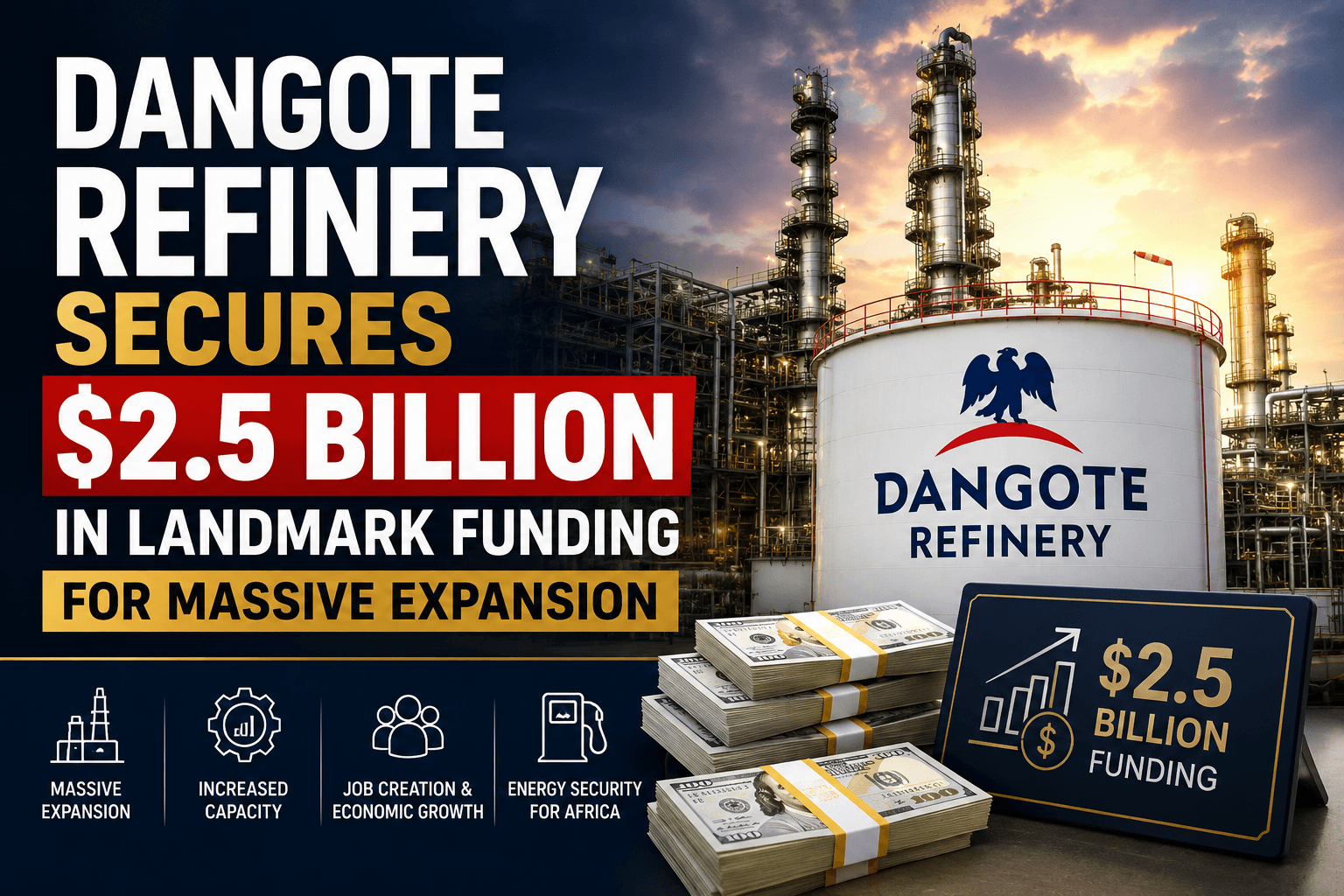
Dangote Refinery has raised $2.5 billion in a landmark private equity deal to fund its expansion. Here’s what the funding means for Nigeria and Africa’s energy security.
Dangote Refinery’s $2.5 Billion Funding Deal: What It Really Means for Africa
Aliko Dangote just pulled off something no private company on the continent has managed before. On July 23, the Dangote Petroleum Refinery and Petrochemicals confirmed it had closed a $2.5 billion private equity placement — money it says will fund the next stage of its expansion, deepen its ownership base, and set the stage for a public listing before the year is out.
It’s a big number, but the bigger story is what it signals: that African industrial ambition can now be financed largely by African and international private capital, not just government balance sheets or multilateral loans. For a project that’s already reshaped Nigeria’s fuel supply chain, this deal pushes Dangote’s refinery toward something even more consequential — becoming the largest refining complex on Earth.
Breaking Down the Deal
According to the company’s own statement, the placement was oversubscribed by 3.7 times the original offer size, with roughly 3.7 trillion subscription units issued to a broad mix of African and international institutional investors. Dangote Petroleum Refinery and Petrochemicals (DPRP) called it Africa’s largest publicly disclosed primary equity private placement by value.
What makes this raise different from previous Dangote financing rounds is who’s involved. Until now, the Nigerian National Petroleum Company Limited (NNPCL) was the only outside shareholder in the refinery, holding roughly a 7.2% stake. This placement changes that. It marks the first equity funding round involving external investors beyond the company’s legacy shareholder base, according to DPRP.
Reports on the transaction point to Africa Finance Corporation and an Afreximbank-facilitated investment vehicle among the backers, alongside international players including India Infra Buildco. In effect, Dangote has widened his shareholder table just months before opening it up further through a public offering.
Speaking on the deal, Aliko Dangote framed it as a complement to what the company already has coming in through operations and existing loans. The new funds, he said, would provide “capital to complement internal cash flows and external funding” as the refinery “advances its expansion agenda.”
Why This Round Is Separate From the Afreximbank Loan
There’s a detail worth clarifying, because headlines from earlier this year can easily get mixed up with this latest news. Back in April, the African Export-Import Bank (Afreximbank) underwrote $2.5 billion of a separate $4 billion syndicated term loan for the refinery, arranged jointly with Access Bank. That facility was structured to consolidate existing debt and optimize DPRP’s capital structure — essentially a refinancing and balance-sheet cleanup exercise.
This July’s $2.5 billion is a different animal entirely. It’s fresh equity, not debt, and it’s tied directly to expansion rather than restructuring. Afreximbank President George Elombi has since confirmed the bank’s continued role in the refinery’s growth, noting the institution had committed $2.5bn towards the planned expansion after Dangote sought about $4bn in financing. Taken together, the two moves show a company stacking multiple financing tools — debt, equity, and multilateral support — to fund a genuinely massive buildout.
The Expansion Numbers Behind the Headline
So what is all this capital actually buying? The current Lekki complex processes 650,000 barrels per day, already making it Africa’s largest refinery. The plan is to more than double that.
Dangote intends to lift capacity to 1.4 million barrels per day by 2028, which would overtake India’s Jamnagar complex as the world’s biggest single refining site. That’s not a modest tweak — it’s close to doubling the physical output of a facility that only began commercial operations a little over two years ago.
Industrial Info Resources, which tracks project-level industrial spending, says the Lekki expansion alone spans 17 projects worth more than $7 billion in investment. That figure gives a sense of scale: the $2.5 billion raised this month is a significant chunk of the funding puzzle, but far from the whole picture.
The expansion isn’t confined to Nigeria, either. Dangote is planning to build a 700,000-barrels-per-day refinery in Lamu, on Kenya’s coast, extending the group’s refining footprint into East Africa for the first time. That project alone reflects a broader continental strategy — one aimed at reducing Africa’s dependence on refined fuel shipped in from overseas.
Setting Up for an IPO
None of this happens in isolation from Dangote’s other big move this year: a planned initial public offering. Analysts describe the private placement as “a precursor to the initial public offer where investment in the refinery would be open to the public later in the year.”
Valuation estimates have moved around as the process has progressed. Earlier fundraising documents reportedly valued the business at around $39 billion, while more recent estimates have placed a possible listing valuation near $40 billion. The strong demand seen in this private placement — that 3.7x oversubscription — gives Dangote a useful data point heading into IPO talks, even if final pricing and timing will depend on regulatory approvals and market conditions.
Why This Matters Beyond Nigeria
It’s tempting to read this purely as a corporate finance story — a big company raising a big round. But the bigger context is Africa’s chronic reliance on imported fuel, and the enormous cost that comes with it.
According to the State of Africa’s Infrastructure Report 2026, the continent imports more than 70% of its refined fuel and spends about $230 billion annually on essential products including fuel, food, plastics, steel and fertiliser. That’s not a rounding error in national budgets — it’s a structural drain that shows up in currency pressure, trade deficits, and vulnerability to global supply shocks.
This is precisely the vulnerability the Dangote refinery was built to address, and Afreximbank’s leadership has been vocal about the results so far. George Elombi has pointed out that the refinery played a role in stabilising the naira by reducing Nigeria’s dependence on imported petroleum products, and that it proved its worth during recent geopolitical turbulence: “The crisis in the Gulf has happened; oil prices fled, but Africa didn’t lack in its refined petroleum products,” he said.
Elombi didn’t mince words about why the bank keeps backing the project either. “We take immense pride in being the single largest provider of financing to the Dangote Group. We do so primarily because Dangote is African,” he said, adding that Afreximbank has committed about $15billion to Dangote Group since 2015.
What to Watch Next
A few threads are worth following as this story develops through the rest of 2026:
- The Lagos-listed IPO timeline. With private placement demand this strong, pressure will build on Dangote to move quickly, though regulatory sign-off will set the real pace.
- Progress on the Kenya refinery. The Lamu project represents Dangote’s first major refining push outside Nigeria, and it will be a genuine test of whether the group’s model travels.
- Capacity milestones toward 1.4 million bpd. Hitting that 2028 target would cement the refinery’s position as the world’s largest, a title with real geopolitical weight for Nigeria and the continent.
- Ripple effects on Nigeria’s downstream fuel market, including pump prices and export potential, as expanded capacity comes online.
The Bottom Line
This $2.5 billion raise isn’t just about one company’s balance sheet. It’s a marker of how African-led industrial projects are increasingly able to attract serious private capital — capital that used to flow almost exclusively toward extractive industries or infrastructure backed by multilateral lenders. Whether Dangote hits its 1.4-million-barrel target on schedule, or the Kenya refinery gets built as planned, this funding round has already shifted the conversation about who finances Africa’s energy future — and it increasingly looks like Africa itself.
Disclaimer:
This article is based on publicly available news reports and statements from Dangote Petroleum Refinery and Petrochemicals, Afreximbank, and other cited sources as of late July 2026. Financial figures, valuations, and project timelines are subject to change based on regulatory approvals, market conditions, and company disclosures. This content is for informational purposes only and does not constitute investment or financial advice.




Here you are
Great post,Thanks for sharing